Zero Sum Enemies Guide: Primes, Factorials, Bosses & More
Learn how Zero Sum enemies work, from primes and factorials to tanky numbers and all nine bosses, plus tips to land clean kills and keep your combo alive.
Jump to
How Numbers Fight Back
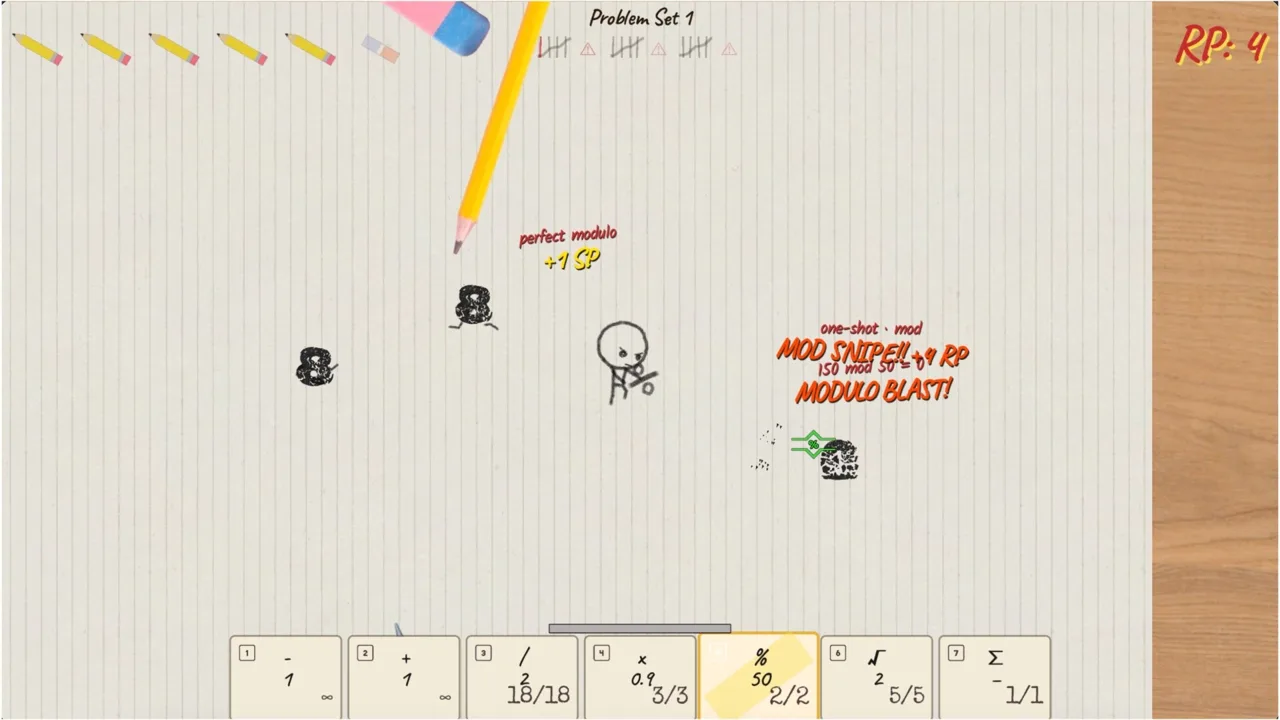
Zero Sum enemies have no health bars. Every enemy is a live integer, and you kill it by bringing its value to exactly zero with your operators. That means the number itself is the threat. A 48 dies cleanly to a few ÷2 shots and then some minus fire. A 47 laughs at division until you nudge it. Read each number before you fire, because the right operator depends entirely on its value.
The core rules that shape every fight:
- Clean kills only for the big operators. ÷ needs an even number (or a clean divisor), √ needs a perfect square, and % pays off when it leaves exact zero.
- Sloppy shots spawn more enemies. A remainder doesn't just vanish. It becomes another number on the field, and it breaks your Clean Combo streak.
- Clean math pays. Chaining clean kills across different operators builds the Clean Combo Multiplier, and a Perfect Wave with no messy remainders gives a big bonus payout in shop currency (RP).
- Trivial shots don't count. Using -1, +1 or ×1 never counts as a clean combo. A minus shot of 2 or more that zeroes a number, like firing a 2 at a 2, does count.
Number Types and How to Break Them
 Image: Steam / Power Plins Games
| Enemy type | What it does | How to handle it |
|---|---|---|
| Even / composite numbers | Standard targets | Divide down, then finish with minus |
| Primes | Shrug off clean division | Shift them with + or − into a clean multiple first |
| Perfect squares (16, 256, …) | Vulnerable to √ | Root them for instant, clean progress |
| Factorials | Split and grow exponentially if ignored | Deal with them early, before they multiply |
| Negatives | Flip your usual setup | Plan for operators to work in the opposite direction |
| Tanky numbers | Slow, stationary or walking, often with high values | Save root and modulo for them |
| FAST numbers | Faster movement | Kite them and keep dash ready |
The texture on a number always means something, on bosses too. Learn to read it before you pull the trigger. Factorials below 2 no longer spawn, so every factorial you see is worth respecting.
A few operator matchups worth memorizing:
- Sigma (Σ) vacuums a swarm of small numbers into one big target that divides cleanly. It's your answer to a screen full of small numbers.
- Modulo can delete huge numbers in one hit if the result lands on zero. The A Big Deal achievement asks you to kill a 6-digit number with a Modulo Blast Smart Play.
- Multiplication upgrades downward (1 → 0.9 → 0.8 …), so it's a control tool. It drops slowing traps and freeze lines rather than killing outright.
- Root Wall sweeps across the whole map and roots everything it touches. It's brutal against clusters of perfect squares.
Enemy Behavior: Walking, Running and Chasing
Numbers move in three states: walking, running and chasing. Hitting a number triggers its aggro and it starts running at you. How long that lasts depends on difficulty:
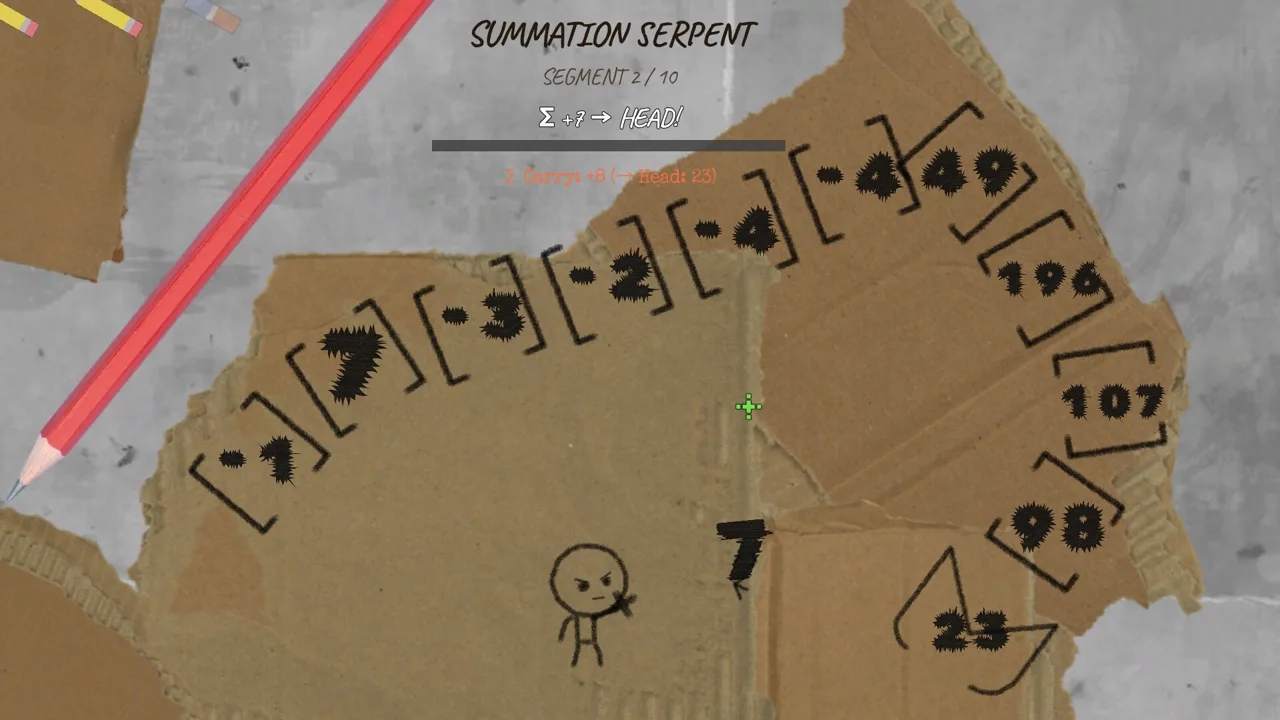 Image: Steam / Power Plins Games
| Difficulty | When numbers start running | Do they lose aggro? |
|---|---|---|
| Pupil (Easy) | Only after the 2nd hit; numbers are slightly slower overall | Yes, and faster |
| Student (Normal) | After the 1st hit | Yes, after a while |
| Teacher (Hard) | After the 1st hit | No |
On Pupil, Tanky numbers also drop into a walk first and only charge after the second hit. Pupil is the only difficulty with an active pause, too.
Difficulty also shifts the values you face. Every difficulty uses the same minimum and maximum number brackets, but Easy weights spawns toward the low end and Hard pushes them toward the high end.
Crowds behave differently too. When numbers bunch up too tightly, or you kite a group around for too long, they spread out for a moment before re-engaging. Use that breathing room to line up clean shots instead of panic-firing -1.
Use these movement tips:
- Dash through chargers. A number charging you won't stop its charge, so dashing through it gives you instant distance.
- Invest in sprint and dash. Once aggro wears off on Pupil and Student, mobility upgrades let you reset a bad wave instead of being chased down.
- Don't misfire on Teacher. Aggro never resets there, so one sloppy hit can follow you for the rest of the wave.
Where Each Enemy Mix Shows Up
Each of the six arenas leans on a different enemy mix:
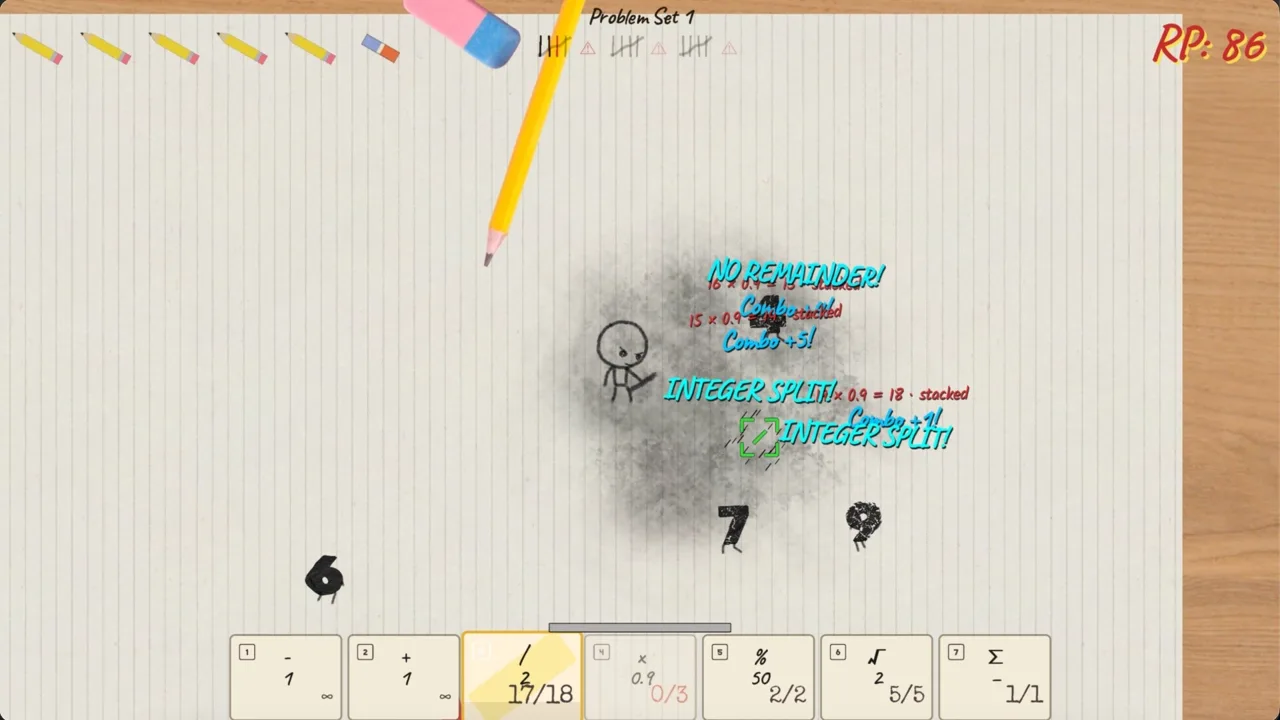 Image: Steam / Power Plins Games
- Writing Paper: the starter map. It has slower spawns and smaller, fewer numbers.
- Math Paper: no stationary Tanky numbers and no factorials, but much higher values with fewer enemies overall.
- Cardboard: heavy on slow, Tanky numbers that block your path while you survive a timer. As of v1.1.0, Tanky enemies no longer spawn stacked on each other, and remainders can't be knocked out of the arena.
- Receipt Paper, Blank Paper and Book Pages: Book Pages is the factor-hunting map, and Receipt Paper is scored on how long you survive.
Before a wave you can also take on a challenge that makes it harder in exchange for SP. Some of these change the enemies directly:
- Every number spawns as a prime
- All enemies spawn at ×7 value
- All enemies spawn negative
- Every enemy is the FAST type
Take the prime challenge only when you have plenty of + and − ammo, because every target needs a nudge before division works.
The Nine Bosses
Each boss is built on a math concept, and bosses are tiered by difficulty. Which bosses you meet depends on the map, and Teacher difficulty unlocks extra boss phases. Unlock rates for each boss's achievement show how far most players get:
| Boss | Gimmick | Achievement | Players who have it |
|---|---|---|---|
| Factorial Factory | Fires factorial shells. A 9! bursts into 9 × 8 × 7 × … and tries to recombine | Factory Reset | 15.1% |
| Summation Serpent | Segments need 2–3 operator hits to reach zero cleanly; a timer adds pressure, and on Teacher the head chases you | Snake Charmer | 11.1% |
| Pi Pie | A spinning pie armored with the digits of π; strip the slices in order | Easy as Pi | 11.1% |
| Euler Owl | Taylor-series projectiles that duplicate in flight | Owl's Well | 6% |
| Prime Sieve Spider | Its web is a live Sieve of Eratosthenes; shoot a prime and it breaks free to hunt you | Web of Primes | 6% |
| Yin-Yang Harmony | A positive half and a negative half; over-damage one and the other goes berserk | Balanced Equation | 5% |
| Root Reaper | Root-themed boss | Root Canal | 4% |
| Matrix Mantis | Matrix-themed boss | Determinant Zero | 4% |
| Matryoshka Madness | Nested-shell boss | Unboxing Day | 2% |
Tips for the toughest fights:
- Factorial Factory: zero the fragments before they merge back into their product. A recombined 9! is a far bigger problem than its pieces.
- Summation Serpent: root can only be the first operator on a segment. Look for patterns like ÷ → ÷ → −, √ → − → −, or + → + → %.
- Euler Owl: cut each volley down right away. Every duplicate you ignore adds another term to the expansion.
- Prime Sieve Spider: only shoot composites. Leave the primes alone.
- Yin-Yang Harmony: alternate plus and minus to keep the harmony meter balanced. If one side enrages, you get swarmed.
Only 20.2% of players have beaten any boss at all (Pop Quiz Passed), and just 1% have Dean's List for beating every boss. If Matryoshka Madness is your last one, you're in good company.
Turning Enemy Knowledge Into Score
Leaderboard score rewards how you kill, not just whether you survive. Perfect waves, combo chains, flawless runs and time under par all add points. Damage taken and shop heals cost you.
- Check every number before you fire. Is it even, prime or a perfect square? That one glance decides which operator gets a clean kill.
- Ration division early. Ammo is limited in the first runs. Minus down a 72 if you're short, but spend ÷ when it keeps a combo alive.
- Hold √ for the big squares. A tanky 256 is a better root target than a cluster of 16s you could handle with other operators.
- Merge swarms with Σ. Fewer, bigger numbers are easier to solve cleanly than a crowd of small ones, and a sum over 9000 unlocks That's Over 9000!
- Open the Teacher's Combo Guide in the loadout. It explains how the combo system works and adds some info about enemies, including that dashing through a charging number buys you distance.
Ready to start shooting down angry digits? Grab Zero Sum on Steam or check the Power Plins Games website for the free demo.
Continue with
 Zero Sum Remainders Explained: Clean Kills and CombosMessy Zero Sum remainders spawn extra enemies and wipe your combo. Learn how clean division, roots and modulo work, plus tips to keep every wave perfect.
More in Enemies
See all Enemies
Continue exploring
Join the community
Official channels for news, updates and player help: