Zero Sum Modes Guide: Standard, Verdict, Target and More
Our Zero Sum modes guide breaks down Standard, Verdict and Target modes, every paper arena, difficulty tiers and the Problem Set editor. Plan your run.
Jump to
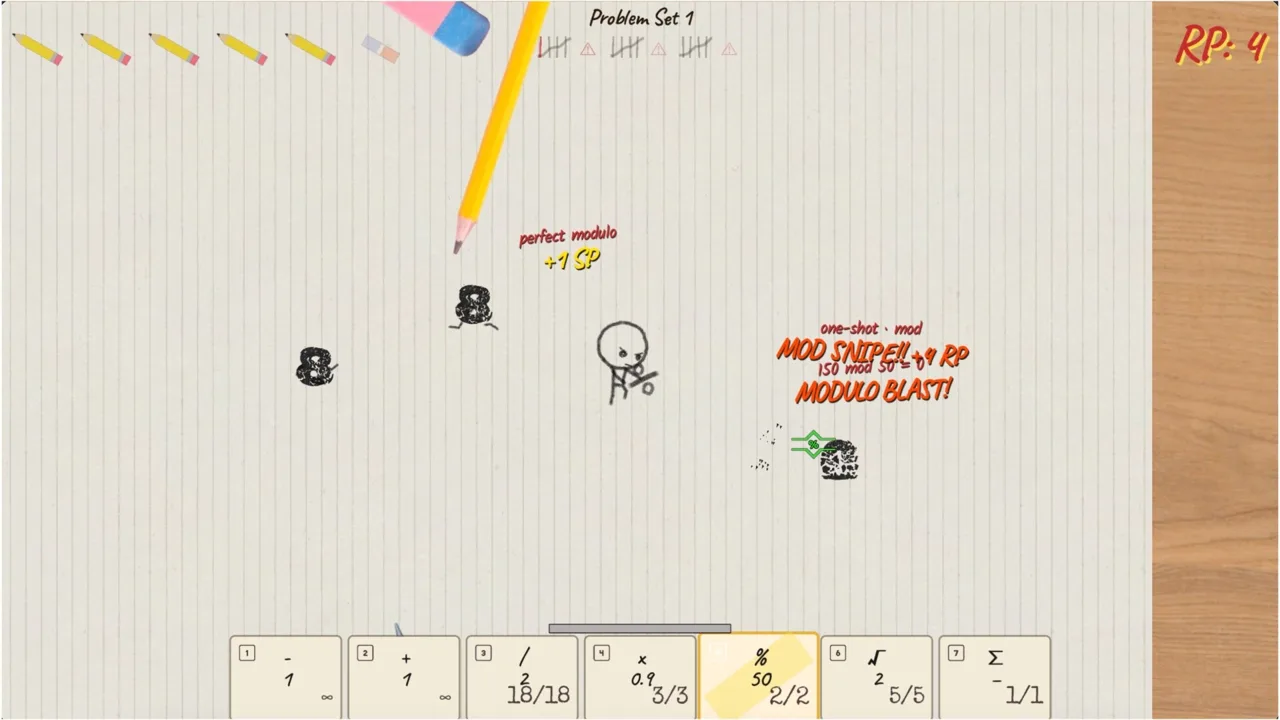
Zero Sum looks like one long twin-stick roguelite, but each mode asks for a different kind of math. In one you chip numbers down to zero. In another every shot gets graded. A third asks you to build numbers up to a target instead of erasing them. This Zero Sum modes guide covers the three combat rule sets, the six paper arenas, the difficulty tiers and the Problem Set editor, so you know what each one tests before you commit a run to it.
The Three Combat Rule Sets at a Glance
Zero Sum launched on November 17, 2026 with three combat rule sets spread across 6 arenas. There is also a full challenge editor on top of them.
| Mode | Goal | Key operators | What it tests |
|---|---|---|---|
| Standard | Reduce every enemy to exactly zero | Operators unlocked in the skill tree | Ammo management, combos, build growth across a run |
| Verdict | Survive an endless gauntlet where ÷, √ and % either solve cleanly or punish you | Drafted mid-run | Precision and knowing your divisibility rules |
| Target | Turn each number into a specific target value within an operation limit | +, × and Σ | Planning a short equation before you fire |
Standard Mode: The Core Roguelite Loop
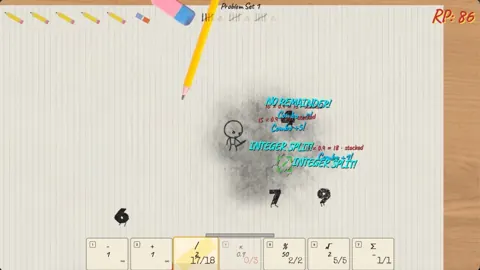
Standard is the main game. Runs alternate between waves and a shop. You earn RP, the run currency, during waves and spend it between them on ammo restocks and operator upgrades. A full run is 15 waves, which is why the Flawless Transcript achievement asks you to clear all 15 perfectly.
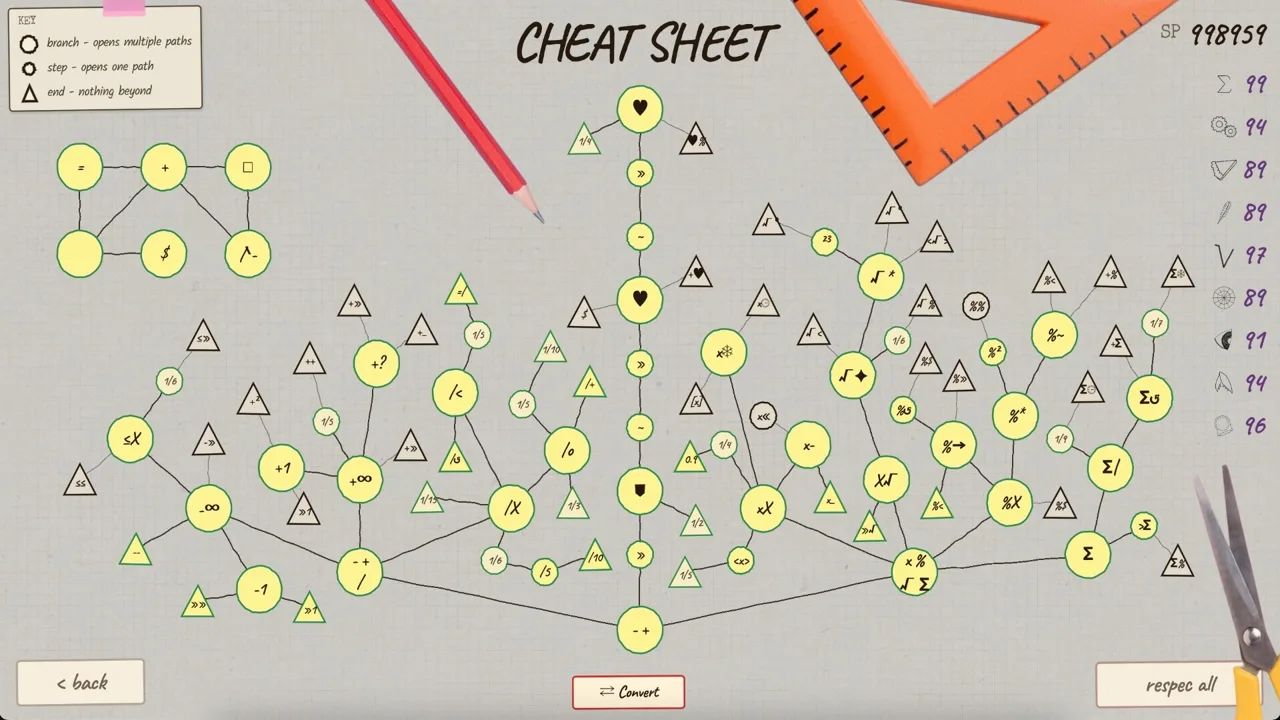 Image: Steam / Power Plins Games
Clean math is what makes RP flow. Examples of clean kills:
- Dividing a number with no remainder
- Rooting a perfect square
- Landing a modulo that leaves exactly zero
Chaining clean kills across different operators builds Clean Combo Multipliers. A Perfect Wave pays out a big bonus. Sloppy shots spawn extra enemies and break your streak. Plain −1, +1 and ×1 don't count toward combos at all.
Before a wave you can draft wave challenges. These make the next wave harder, for example:
- Every number spawns as a prime
- All values are ×7
- All enemies spawn negative
- Every enemy is FAST
- You take double damage
In exchange you pay a reduced RP cost and earn SP, the meta currency for the 100+ node skill tree. The double boss drop modifier before each boss is still offered too.
Tips for Standard:
- Ration division ammo early. Minus a 72 down shot by shot only when you can't afford the clean combo.
- Save root for tanky perfect squares like 256 rather than spending it on a cluster of 16s, unless the cluster is the bigger threat.
- Learn the Sum Barrier upgrades. If you reduce a barrier full of absorbed numbers to 0, you earn SP equal to the number of enemies it swallowed. That makes it a strong SP farming tool.
- Open the Teacher's Combo Guide in the Loadout screen if Perfect Waves aren't happening. It explains the combo system in far more depth than the short tutorial.
Verdict Mode: Every Operation Gets Judged
Verdict is the precision gauntlet. It is endless survival with operator drafting mid-run. Division, root and modulo either solve a number cleanly or punish you for the attempt. There's no spraying minus and hoping.
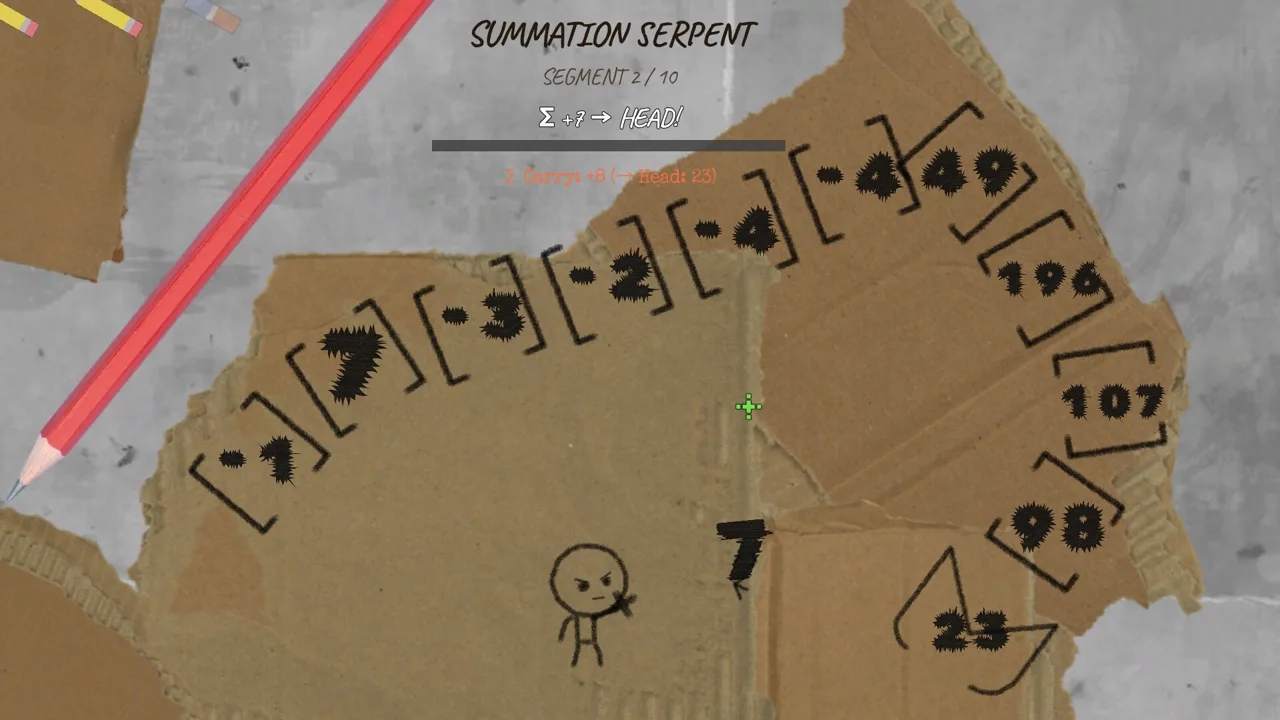 Image: Steam / Power Plins Games
Tips for Verdict:
- Check divisibility before you fire ÷. Even numbers only for ÷2.
- Keep √ for perfect squares only.
- Use + or − to nudge awkward values, like primes, into something that divides cleanly. Then commit to the judged operator.
- Draft operators that cover each other's gaps. A loadout with nothing to fix a prime will stall fast.
Target Mode: Build Up Instead of Down
Target flips the core rule. Each number has to land on a specific target value, using +, × and Σ, within a strict operation limit. Since v1.1.0, a number that runs out of operations without hitting its goal counts as a miss and leaves the field. That keeps the wave moving instead of softlocking it.
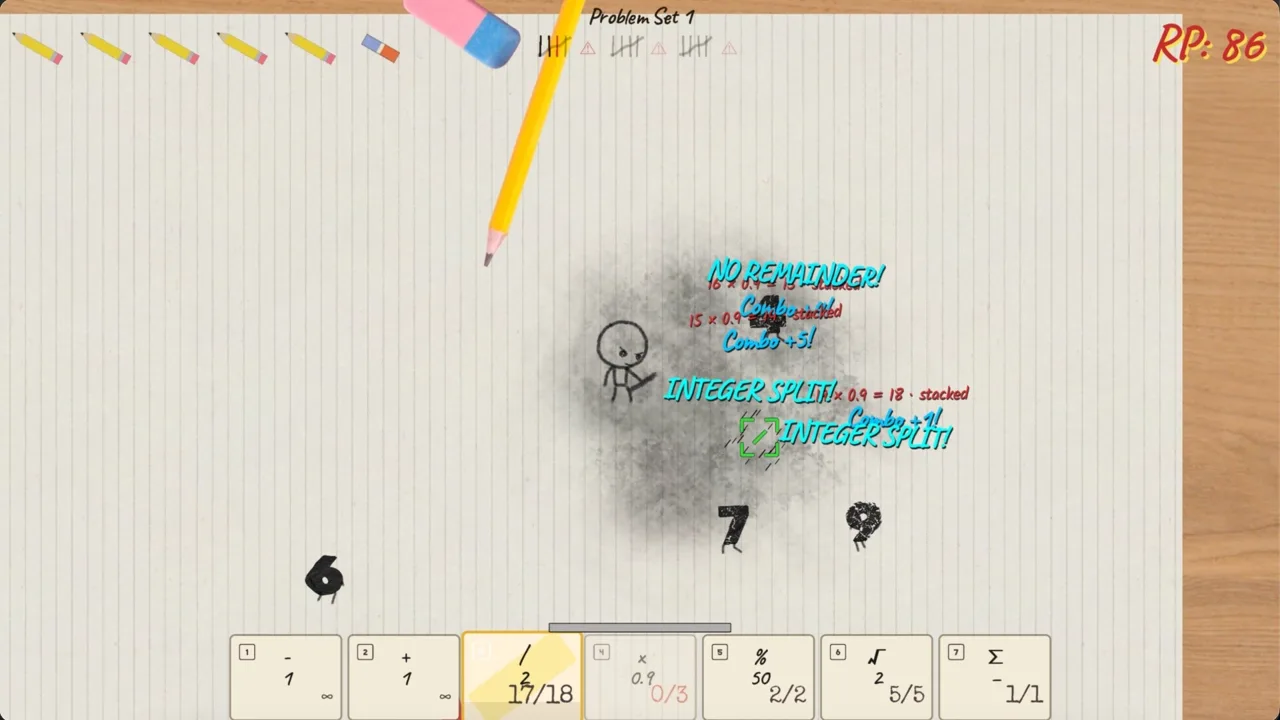 Image: Steam / Power Plins Games
Tips for Target:
- Work backward from the target before your first shot. With a tight operation cap, one wasted + can make the number unreachable.
- Use Σ to merge small numbers when the target is larger than anything on screen.
- Expect misses to cost you. A number that times out is gone, so prioritize the ones you've already invested operations in.
The Six Paper Arenas
Each map plays like its own mode, with its own bosses and wave makeup. Each map also has its own achievement, and their unlock rates show how steep the climb gets:
| Arena | Character | Achievement | Unlock rate |
|---|---|---|---|
| Writing Paper | The starter map: slower spawns, smaller and fewer numbers, factorials in the mix | Writing Paper | 5% |
| Math Paper | Conveyor-style map: no stationary tanky numbers, no factorials, fewer but much higher values | Function Fields | 1% |
| Blank Paper | Full-run arena | Blank Paper | 3% |
| Book Pages | Factor-hunting rule set | Book Pages | 1% |
| Cardboard | Heavy on TANKY enemies | Cardboard | 0.1% |
| Receipt Paper | Survival scoring | Receipt (survive 5 minutes) | 0.1% |
Receipt Paper scores differently from the others. Its leaderboard weights time survived, bonuses for reaching phases 3, 4 and 5, a raw SP gain multiplier, a mistake penalty and an efficiency bonus.
On the other maps, score comes from:
- Waves cleared and bosses defeated
- Completion and flawless runs
- Perfect waves and combo chains
- Time under par
- Deductions for damage taken and shop healing
Every map has its own Steam leaderboard for each difficulty.
Difficulty Tiers: Pupil, Student, Teacher
Zero Sum has three difficulty tiers. Enemies have internal aggro. They walk, then start running at you once you hit them.
- Pupil (Easy): Numbers are a bit slower and start running only on the second hit. Tanky enemies walk first. Numbers lose aggro faster, so one misfire doesn't snowball. Pupil also has an active pause.
- Student (Normal): The intended difficulty. Numbers run after the first hit but drop aggro after a while.
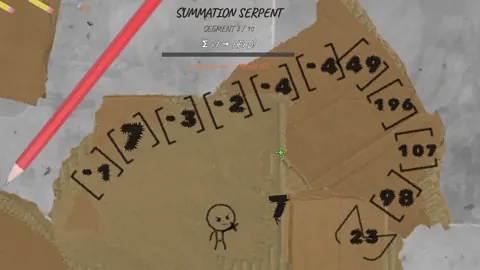
- Teacher (Hard): Numbers never lose aggro. Hard also unlocks extra boss phases, such as the Summation Serpent charging you at double speed for 3.5 seconds after you break a segment.
The difficulty-specific run achievements are rare. Warm-Up Complete (Easy) sits at 2%, Curriculum Cleared (Normal) at 4%, and Valedictorian (Hard) at 0.1%.
If the speed overwhelms you, start on Pupil. Make the most of sprint and dash, because dashing through a charging enemy opens distance without stopping its charge.
Problem Sets and the Challenge Editor
The Problem Set editor lets you design your own waves, including:
- Number patterns
- Fixed operator loadouts
- Traps
- Resolution rules
Built-in validation flags unsolvable setups before you export. Each set compresses into a shareable code. Anyone can import it, play it and get graded on a Report Card. You can set grade thresholds, the teacher's name and a custom verdict for each grade.
v1.1.0 (November 19, 2026) changed a few editor rules:
- List patterns now spawn numbers in the order you typed them. Codes shared before the patch that use a List pattern may play slightly differently.
- Scripted sets always include Pattern 0 and Loadout 0. A new scripted wave defaults to a 3–20 range, goal 2 and 5 operations, so it works in every mode.
- The "On wrong hit" setting now shows in Target mode, where it already applied.
The editor also doubles as a learning tool. Limit the loadout to + and − for a younger player, or lock everything except division to drill factors. Post finished codes in the developer's Custom Challenge Codes thread in the Zero Sum Steam community discussions to share them, and grab the game itself on the Zero Sum Steam page.
FAQ
Which difficulty is Zero Sum balanced around?
Student (Normal) is the intended experience. Pupil gives you more breathing room plus a pause. Teacher removes aggro reset and adds new boss phases.
Why didn't my Target mode wave end?
Before v1.1.0, a number that ran out of operations could linger and softlock the wave. Update to v1.1.0 or later, where those numbers count as misses and leave the field.
Will older Problem Set codes still work?
Yes, they still import. Sets built on List patterns may spawn in a different order since v1.1.0, so re-test anything you shared before the patch.
Continue with
 Zero Sum Target Mode Guide: Rules, Tips and Custom PuzzlesZero Sum Target Mode flips the goal: turn numbers into a target value with +, × and Σ under a strict operation limit. Get the rules, tips and share codes.
More in Modes
Zero Sum Arenas Guide: Every Map, Mode and Scoring Twist
Zero Sum arenas explained: Writing Paper, Math Paper, Cardboard and Receipt Paper, plus Verdict and Target rules, leaderboards and tips to score higher.
Zero Sum Challenge Codes: How to Share and Play Problem Sets
Zero Sum challenge codes turn custom problem sets into shareable puzzles. Learn how to build, import and grade them, plus a Prime Riddle code to try now.
Zero Sum Challenge Editor: Build, Share and Grade Puzzles
Master the Zero Sum challenge editor: build custom problem sets, set grade thresholds, share codes with friends or chat, and learn the v1.1.0 changes.
Zero Sum Difficulty Guide: Pupil, Student or Teacher?
Zero Sum difficulty explained: how Pupil, Student and Teacher change enemy speed, aggro, pause and boss phases, plus tips to pick the right tier for you.
Continue exploring
Join the community
Official channels for news, updates and player help: